AI And Our Children: Rethinking Education In The Age Of AI – Part 2
Helping Children use AI to Learn without Letting it do the Thinking for Them

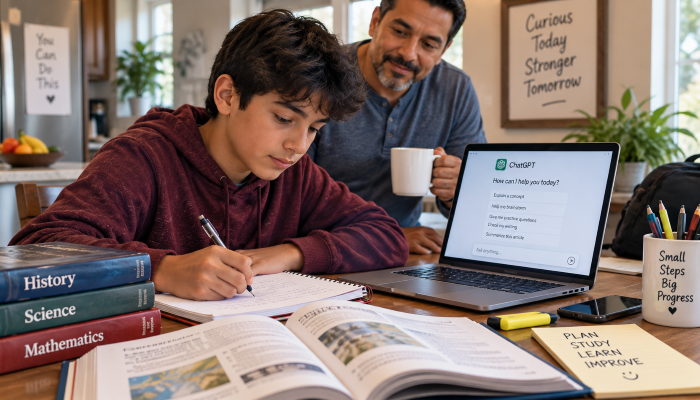
As we explored in Part I of this series, Artificial Intelligence (AI) is already changing how children learn and do schoolwork. AI is changing more than how quickly students can complete an assignment. It is forcing teachers and parents to ask a more important question: What did the child actually learn?
A polished essay, correct answer, or impressive presentation no longer tells the whole story. AI can help students research, organize ideas, receive feedback, and practice difficult material. It can also do so much of the work that the finished product hides whether meaningful learning happened.
The goal shouldn’t be to remove AI from education. That is neither realistic nor wise. The challenge is to use it without allowing it to replace the thinking, persistence, and judgment children are still developing.
Teachers May Need to Rethink Homework and Testing
AI creates a practical challenge for teachers:
How do you determine what a student actually knows when AI can produce much of the assignment?
For generations, essays, research papers, homework, and take-home projects have helped teachers evaluate learning. Those assignments don’t necessarily need to disappear, but teachers may need to change how they use them.
Schools may increasingly need a combination of AI-assisted and AI-free work.
An AI-assisted research project can teach students to use technology responsibly, verify information, recognize weak sources, and work efficiently.
An AI-free assignment can demonstrate whether students can organize their thoughts, construct an argument, solve a problem, and communicate without technological assistance.
Both abilities matter.
Some Struggle Is Part of Learning
There is another reason students still need opportunities to work without AI: some mental struggle is part of learning.
A child strengthens important abilities while searching for the right word, working through a math problem, organizing an argument, remembering information, and figuring out why an answer is wrong. Frustration isn’t always pleasant, and adults shouldn’t create difficulty for its own sake. However, stepping in too early can remove the effort that helps new knowledge take hold.
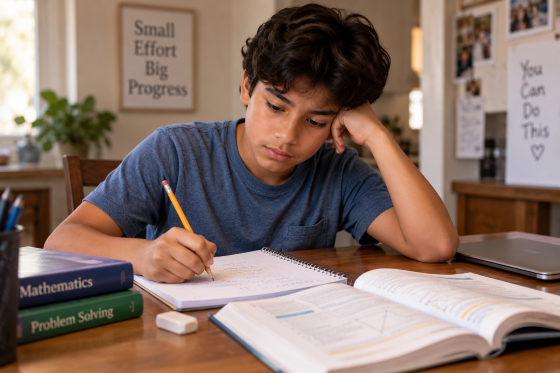
AI makes that temptation especially powerful because it can remove the struggle almost instantly. A student may produce better work with a chatbot without developing the skill needed to do the task independently.
The OECD Digital Education Outlook 2026 draws an important distinction between completing a task successfully and actually learning from it. The OECD reports that general-purpose AI can improve the quality of students’ work while encouraging them to offload too much thinking. In some studies reviewed by the OECD, the advantage disappeared, and sometimes reversed, when students later had to perform without AI.
That doesn’t mean every use of AI weakens learning. It means timing and purpose matter. Let the child attempt the problem, make a mistake, and explain what is confusing before AI provides help.
If AI removes the effort required to learn something, might it also remove part of the learning?
One Teacher’s Practical Approach
A teacher friend recently told me how she’s addressing this challenge in her classroom.
She has her students write essays in class without AI assistance. Over time, she becomes familiar with each student’s natural writing – the vocabulary, sentence structure, organization, reasoning, and individual voice.
Then, when students submit essays written outside the classroom, she has something valuable for comparison.
If a student’s writing suddenly bears little resemblance to what that student normally produces, she can recognize the difference and ask questions about the work.
I like her approach because it doesn’t depend entirely on technology to police technology. She’s getting to know her students.
Of course, differences in writing don’t prove AI was used. Students have more time to edit at home, may receive legitimate help, and naturally improve. However, a dramatic change can provide a reason to talk with the student and determine whether he or she actually understands the submitted work.
Instead of focusing only on “Did this student use AI?” teachers may increasingly need to ask, “Can this student demonstrate that he or she understands the work?”
The Oral Defense Could Make a Comeback
After submitting a research paper, imagine a student spending five minutes discussing it with the teacher. The questions could be simple:
- Why did you choose this thesis?
- Which source was most persuasive?
- Which evidence challenged your position?
- What did you learn that surprised you?
- What would cause you to change your conclusion?
- How did you use AI, if you used it?
- Which AI-generated information did you independently verify?
A student who genuinely researched the subject should be able to discuss those questions. A student who simply asked AI to produce the paper may struggle.
More importantly, an oral defense shifts the conversation from catching students cheating to demonstrating learning.
An AI Tutor Isn’t the Same as an AI Answer Machine
Used well, AI can do more than provide shortcuts. It can explain a concept several ways, generate practice questions, offer hints, and give a student another opportunity to work through material that remains confusing.
The difference lies in what the AI asks the student to do. A purpose-built educational tutor can question, nudge, and adjust its approach. A general chatbot may simply hand over the answer unless the student, teacher, or parent deliberately asks it not to.
The OECD reports that educational AI used with a clear teaching purpose is more likely to produce lasting learning gains. A 2025 randomized controlled trial published in Scientific Reports also found that a carefully designed AI tutor produced stronger learning gains than an active-learning classroom lesson in one undergraduate physics course. That finding is encouraging, but it involved college students. We shouldn’t assume that a general chatbot will produce the same results for younger children.
Parents can help a child use AI more like a tutor by changing the request. Instead of asking, “What is the answer to this algebra problem?” the student might say, “Don’t give me the answer. Help me solve it myself. Ask me questions and give me one hint when I get stuck.”
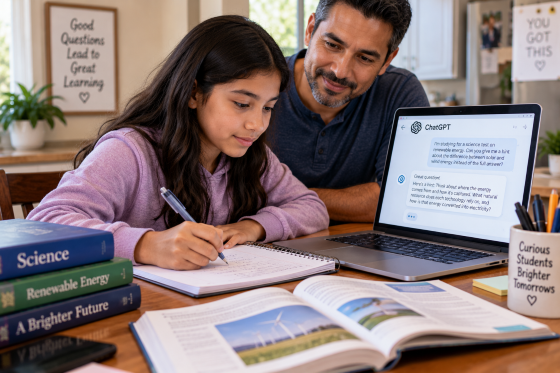
In that role, AI supports the child’s thinking instead of replacing it.
What If Students Were Asked to Catch AI’s Mistakes?
Teachers could also turn AI’s weaknesses into assignments.
Instead of telling students not to use AI, give them an AI-generated response and ask them to investigate it. Students might be asked to:
- Verify every significant factual claim.
- Locate the original sources.
- Identify unsupported statements.
- Find information the AI overlooked.
- Recognize bias or one-sided reasoning.
- Identify sources that don’t exist.
- Separate facts from opinions.
- Rewrite weak portions of the response.
- Explain why their version is better.
Now the student is evaluating AI instead of simply accepting its answer. That’s critical thinking.
UNESCO’s AI Competency Framework for Students similarly emphasizes critical judgment, ethical AI use, foundational knowledge, and preserving human agency. UNESCO says AI should support human decision-making and intellectual development, not undermine or replace them.
The Process May Become as Important as the Final Paper
AI may also force schools to reconsider what they’re grading.
Instead of evaluating only the polished term paper at the end, a teacher might ask students to submit:
- The original research question.
- Preliminary sources.
- Research notes.
- An outline.
- An early thesis.
- A first draft.
- Revisions.
- The final paper.
- An explanation of where and how AI was used.
- Evidence that important AI-generated claims were independently verified.
The finished paper still matters. But so does the journey that produced it.
We should assess the thinking process. AI makes an impressive finished product easier to produce, so teachers and parents need to understand what learning occurred before that product appeared.
Knowing When Not to Use AI Is Part of AI Literacy
Children need more than instructions on how to write better prompts. They also need the judgment to recognize when using AI would defeat the assignment’s purpose.
AI may be useful for creating practice questions before a history test, explaining a difficult paragraph, or offering feedback on a draft the student wrote. Asking it to write the history essay intended to demonstrate the student’s understanding is different. The first use can support learning. The second may replace it.
Before using AI, a student could pause and ask, “What am I supposed to learn from doing this myself?” If the answer is writing, reasoning, remembering, calculating, or forming an original judgment, that part deserves protection.
This doesn’t require a permanent ban. The child might complete the first attempt independently and use AI later for feedback, comparison, or additional practice. The important point is that using AI should be a decision, not an automatic response to every difficult task.
AI Can Be Wrong and Sound Completely Confident
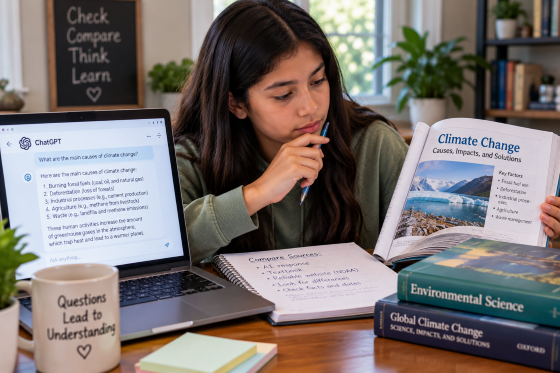
Children also need to understand one of AI’s most important limitations.
An AI response can be beautifully written, detailed, persuasive – and wrong.
Generative AI systems can produce inaccurate information, omit important context, and sometimes generate references that don’t exist.
That’s why AI literacy should include something more important than learning how to write clever prompts. Students need to ask:
- Where did this information come from?
- Can I find the original source?
- Is the source credible?
- Can another reliable source confirm it?
- Is this a fact, interpretation, or opinion?
- What information might be missing?
- Am I accepting this because it’s correct – or because it sounds convincing?
In the AI era, source verification may become more important, not less.
There Is Also an Equity Question
That’s an important potential benefit.
However, AI could also create another educational divide.
Some students will have better devices, reliable high-speed internet, more capable AI tools, well-trained teachers, and parents who understand how to guide their use. Other children may have access to AI but little guidance about how to use it effectively.
The OECD has identified devices, connectivity, digital resources, curriculum-aligned tools, and teacher professional development as important parts of making educational AI equitable.
The future divide, therefore, may not simply be between children who have AI and children who don’t.
It could be between children who know how to think with AI and those who know only how to get answers from it.
Parents Don’t Have to Be AI Experts
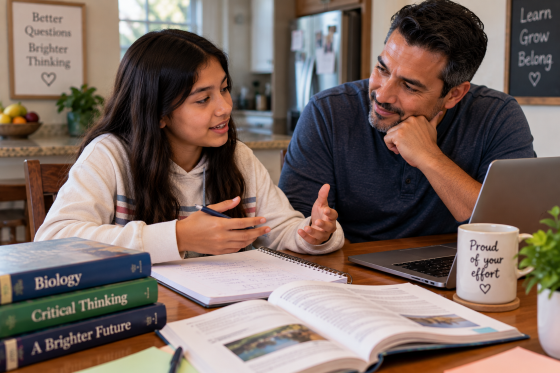
Parents and stepdads don’t need to master every new AI tool. They do need to stay curious about how their children use it.
A few questions can reveal whether AI supported the child’s learning or quietly took over the work:
- How did you use AI on this assignment?
- What part did you do yourself?
- What did AI help you understand?
- Did you verify what it told you?
- Could you explain this to me without using AI?
Those questions aren’t meant to become an interrogation. Asked with genuine interest, they invite the child to explain the thinking behind the finished product.
The real educational challenge isn’t keeping children from using AI. It is making sure AI doesn’t do the thinking they still need to learn how to do themselves.
Coming Next: When AI Becomes More Than a Tool
Helping children use AI for school is one challenge. But what happens when a child begins turning to AI not just for answers, but for advice, reassurance, companionship, or emotional support? In Part III of AI and Our Children, we’ll look at why AI shouldn’t become a child’s confidant – and why parents and stepdads need to stay connected to the conversations technology may increasingly invite.
Sources
OECD Digital Education Outlook 2026
UNESCO AI Competency Frameworks for Students and Teachers
UNESCO Guidance for Generative AI in Education and Research
Kestin and colleagues 2025 AI tutoring randomized controlled trial