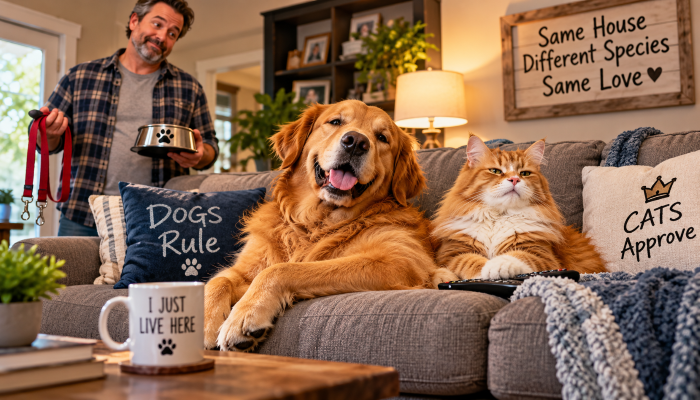
Every family has a chain of command. Dad pays the bills, Mom keeps the household running, and the kids negotiate for more screen time. But as these funny dog and cat facts reveal, the real household authorities often have four legs, fur, and absolutely no intention of following the rules.
The family dog owns the couch, controls the dinner schedule, and has somehow convinced everyone that going outside at 2 a.m. is perfectly reasonable. Meanwhile, the cat supervises from a comfortable position atop your freshly folded laundry.
Of course, let’s be clear. You may have purchased the house, but your pet owns it. You’re simply the person whose name appears on the mortgage.
In honor of National Make a Dog’s Day, celebrated yesterday, October 22, we’re investigating one of life’s greatest mysteries: How did creatures who can’t operate a can opener become the undisputed rulers of millions of households?
And perhaps more importantly, why are we so happy to serve them?
The Family Dog: A Furry Dictator With Excellent Public Relations
For starters, dogs have mastered a leadership technique that would make corporate executives jealous. They demand loyalty, expect immediate service, and reward their employees with occasional displays of affection.
Consider the average dog’s daily responsibilities:
- Sleep approximately half the day.
- Eat meals prepared and delivered by someone else.
- Demand outdoor recreational activities regardless of the weather.
- Bark at delivery drivers performing their legitimate duties.
- Receive praise for using the bathroom outdoors.
Imagine receiving a standing ovation every time you visited the restroom.
“GOOD JOB, DAD! WHO’S A GOOD BOY?”
Your family would probably schedule an intervention.
And yet, when the dog performs this remarkable feat of biological engineering, the entire household celebrates.
Meanwhile, Dad replaces the garbage disposal, repairs the dishwasher, and unclogs the toilet. His reward?
“While you’re up, can you get me something to drink?”
Fun Fact #1: Dogs Can Learn an Impressive Number of Words
In fact, researchers John Pilley and Alliston Reid documented an extraordinary border collie named Chaser who learned and retained the names of 1,022 objects through three years of intensive training. Their findings were published in the scientific journal Behavioural Processes in 2011.
That’s extraordinary, considering my imaginary teenage son apparently cannot recognize the words “take out the trash.”
Even so, the dog understands “walk,” “treat,” “dinner,” and “car ride.” But mention “bath,” “veterinarian,” or “stop licking the sofa,” and suddenly he doesn’t speak English.
It’s selective hearing with a tail.
Come to think of it, perhaps the dog and the teenager have been comparing notes.
Research source: Pilley and Reid, 2011, National Library of Medicine.
Cats: Tiny Landlords Who Allow Humans to Occupy Their Property
By contrast, dogs want to please their owners. Cats want their owners to understand the terms of the lease.
A dog thinks, “You feed me, shelter me, and love me. You must be a god.”
A cat thinks, “You feed me, shelter me, and love me. I must be a god.”
Nobody knows who originally made that observation, but whoever it was clearly understood cats.
Cats have perfected the art of making affection feel like a limited-time promotional offer.

For example, your cat may ignore you for six consecutive hours. Then, precisely when you’re typing an important email, she’ll climb onto your keyboard.
Suddenly, your message to the boss reads:
“Dear Mr. Thompson, I respectfully request approval for the quarterly budget adjustment. jjjjjjjjjjjjjjjjjjjjjjjjj.”
Your cat has submitted her recommendations. And judging by her expression, she expects them to be implemented immediately.
Fun Fact #2: Cats Spend Much of Their Lives Sleeping
According to veterinary guidance published by PetMD, most adult cats sleep approximately 12–16 hours daily. Kittens may sleep even longer, sometimes reaching 20 hours. Cats naturally conserve energy through frequent periods of rest.
That’s not laziness. That’s apparently an executive benefits package.
Beyond sleeping, cats also possess remarkable flexibility and a strong instinct for finding comfortable resting places.
Unfortunately, their definition of “comfortable” includes:
- Your freshly washed laundry.
- The newspaper you’re reading.
- Your laptop keyboard.
- The one chair you’re about to sit in.
- A cardboard box that previously contained a $200 cat bed.
You purchase the finest orthopedic pet bed money can buy. Your cat chooses the shipping carton.
Congratulations. You’ve just spent $200 on packaging.
Research source: PetMD: Why Do Cats Sleep So Much?.
The Great Food Heist: Pets Have No Respect for Personal Property
There’s an unwritten law in every pet-owning household: Any food left unattended becomes community property.
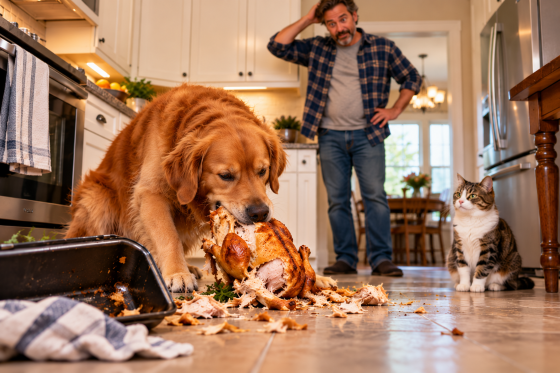
You can spend two hours preparing a magnificent roast chicken, carefully seasoning it with herbs and spices. Place it on the counter for seventeen seconds, and your dog suddenly develops the athletic ability of an Olympic high jumper.
The chicken disappears. The dog sits quietly, pretending nothing unusual has happened, while the cat watches from the windowsill with the detached expression of someone who has already retained legal counsel. Somehow, both animals appear deeply offended by the accusation.
“Who ate the chicken?”
Naturally, the dog tilts his head. The cat yawns. Your stepchild says, “Maybe it was Dad.”
Now you’re the prime suspect in your own kitchen.
Fun Fact #3: Dogs Have an Extraordinary Sense of Smell
Dogs possess highly developed olfactory systems that allow them to detect and distinguish odors humans often cannot perceive. Their remarkable abilities make them valuable in search-and-rescue operations, explosives detection, and certain experimental medical-detection applications.
Some specially trained dogs have demonstrated the ability to identify disease- associated odors under research conditions. However, that doesn’t mean dogs can reliably diagnose illnesses without clinical testing.
Your dog, however, uses this extraordinary biological equipment to locate a French fry that fell behind the refrigerator in 2022.
He can detect a single crumb beneath three layers of furniture but somehow cannot locate the tennis ball sitting directly in front of him.
That’s not a limitation of canine intelligence. That’s a questionable allocation of talent.
Research sources: Canine Olfaction Review and Review of Canine Medical Scent Detection.
The Family Walk: A Democratic Process With One Voter
Consider this: Have you ever noticed that walking a dog is the only family activity where the participant without a driver’s license determines the itinerary?
Dad announces, “We’re going for a quick fifteen-minute walk.” Forty-five minutes later, the dog is still examining the same fire hydrant. Apparently, someone left a fascinating message that requires careful analysis, thoughtful consideration, and an equally detailed response.
Meanwhile, Dad is standing in the rain, holding a plastic bag containing something he’d rather not discuss.
And people say dogs don’t communicate.
Fun Fact #4: A Dog’s Tail Can Communicate More Than Happiness
Dogs communicate through combinations of tail movements, ear positions, facial expressions, posture, and vocalizations. According to the American Kennel Club, a wagging tail doesn’t necessarily indicate happiness. Depending on the circumstances, it can also signal excitement, anxiety, frustration, or heightened alertness.
Humans could learn something from that. Imagine if family members had tails.
You’d know immediately when your teenager was irritated about losing phone privileges. Your spouse’s tail would provide advance warning that your joke about the burned toast wasn’t nearly as funny as you thought.
And the family dog?
He’d still be wagging his tail because somebody opened the refrigerator.
Research source: American Kennel Club: How to Read Dog Body Language.
Pets and Children: The World’s Most Unlikely Criminal Partnership
If you want to discover how quickly children can develop teamwork skills, introduce a family pet.
Suddenly, the child who can’t remember where he left his shoes becomes an expert in covert operations.
“Don’t tell Dad I gave the dog my broccoli.”
The dog understands the arrangement. The child understands the arrangement. Dad wonders why the dog has developed suspiciously healthy eating habits. The partnership continues until the dog makes one critical mistake.
He throws up the evidence on the living room carpet.
Case closed.
But even then, the child insists, “Maybe he found broccoli outside.”
Yes, because wild broccoli frequently migrates through suburban neighborhoods.
Fun Fact #5: Dogs Can Recognize Human Emotional Cues
A 2016 study published in Biology Letters found that dogs could match positive and negative emotional information from human facial expressions and vocalizations. Researchers observed that dogs looked longer at faces whose emotional expressions matched the accompanying sounds.
These findings suggest dogs can recognize and combine different emotional signals, although they don’t establish that dogs understand human feelings in the same way people do.
That may help explain why some dogs respond differently when family members appear upset or distressed.
Still, of course, dogs don’t always get the timing right.
You could be sitting quietly, reflecting on a difficult day, when your dog approaches with what appears to be genuine compassion.
He places his head on your knee, looks deeply into your eyes, and deposits a slobbery tennis ball directly into your lap.
His message is unmistakable.
“I’m sorry you’re sad. Have you considered throwing something?”
To be fair, it’s not the worst advice I’ve ever received.
Research source: Albuquerque et al., 2016: Dogs Recognize Dog and Human Emotions.
The Stepdad’s Greatest Rival May Have Four Legs
As many stepdads know, blended families come with their own relationship dynamics. Stepdads often work patiently to earn trust, develop meaningful connections, and find their place in an established family.
Meanwhile, the family dog arrives and achieves universal acceptance before lunch.
Unlike a stepdad, the dog doesn’t need to understand the custody schedule. He doesn’t worry about whose turn it is to choose the movie. He doesn’t have to navigate complicated conversations about household expectations.
He simply walks into the room, rolls onto his back, and requests a belly rub.
Instant popularity.
A stepdad can spend months demonstrating patience, consistency, and reliability.
The dog sneezes once.
Everyone applauds.
It’s enough to make a grown man consider wearing a collar.
Beneath the jokes, but there’s something genuinely encouraging about the relationship between children and their pets. Animals can provide opportunities for shared responsibility, affection, laughter, and conversation. In some families, a pet becomes a comfortable starting point for building connections.
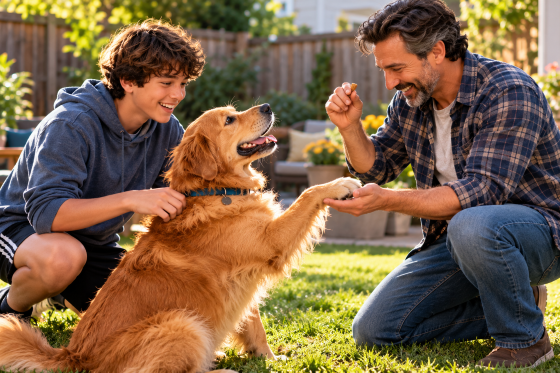
A stepdad who struggles to find common interests with a stepchild might discover that walking the dog, teaching a new trick, or caring for a pet creates valuable time together.
And unlike certain family members, the dog is unlikely to complain that Dad’s jokes are embarrassing.
He’ll simply stare at you.
Which, frankly, may be worse.
The Bathroom Privacy Crisis
Before becoming a pet owner, you probably believed the bathroom was a place of solitude.
How wonderfully naive.
Dogs regard closed bathroom doors as a personal betrayal. Cats consider them an unconstitutional restriction on freedom of movement.
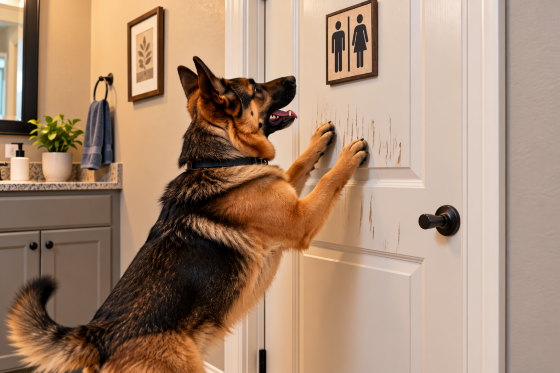
The moment you close the door, the interrogation begins.
Scratch. Scratch. Scratch.
“Are you in there?”
Yes.
“Why?”
Because it’s a bathroom.
“Can I come in?”
No.
“Are you sure?”
Eventually, then comes the dramatic sigh from the other side of the door, followed by a paw reaching underneath.
You haven’t experienced true humiliation until you’ve found yourself negotiating bathroom access with an animal that regularly drinks from the toilet.
And somehow, the pet acts as though you’re the one with questionable hygiene.
The Veterinary Bill: When Love Meets Financial Reality
There’s a special moment in every pet owner’s life when you discover your dog has eaten something spectacularly inappropriate.
A sock.
A television remote.
Half a tennis ball.
An object that appears to have originated from another dimension.
When that happens, you rush to the veterinarian, as swallowing foreign objects can cause serious intestinal blockages and other complications.
The receptionist asks, “What’s the problem?”
“He’s eaten something he shouldn’t have.”
“What did he eat?”
“That’s what we’re hoping you can tell us.”
After examining your dog, the veterinarian explains the situation and presents the estimated treatment cost. You stare at the figure, then at your dog, who responds by wagging his tail as though he has just negotiated an outstanding financial arrangement.
And just like that, your vacation fund becomes the dog’s gastrointestinal recovery fund.
You were planning a week in Hawaii.
Now you’re celebrating the successful removal of a sock.
At least someone got a souvenir.
A Few Dad Jokes Approved by the Family Dog
No Friday Fun Facts & Humor article would be complete without a few jokes guaranteed to produce groans from the children.
Why did the dog sit in the shade?
Because he didn’t want to become a hot dog.
What do you call a dog magician?
A labracadabrador.
Why are cats terrible at online shopping?
They keep deleting everything from the cart.
What kind of dog loves taking baths?
A shampoo-dle.
Why did the dog bring toilet paper to the party?
Because he was a party pooper.
What did the cat say after hearing Dad’s jokes?
“Are you kitten me?”
And my personal favorite:
What’s the difference between a dog and a teenager?
When you ask the dog to go for a walk, he actually gets excited.
Please don’t send complaints. The teenager has already filed several.
Who’s Really in Charge? The Answer Might Surprise You
By now, after examining the evidence, it’s difficult to escape the obvious conclusion.
Our pets have successfully convinced us to provide free housing, gourmet meals, medical care, recreational activities, comfortable furniture, and unlimited emotional support.
In return, they offer companionship, occasional obedience, and the privilege of cleaning up after them. It’s a remarkable arrangement.
How Pets Help Build Stronger Family Bonds
Yet beneath all the comedy lies something worth appreciating. Pets often bring family members together in ways we don’t anticipate. A dog can become the reason a reluctant teenager joins a family walk. A cat’s ridiculous sleeping position can produce laughter around the dinner table. Caring for an animal can give children and stepparents a shared responsibility that gradually develops into something more meaningful.
In a blended family, those ordinary moments matter.
Trust doesn’t always grow through serious conversations or carefully planned activities. Sometimes it develops while teaching a puppy to sit, laughing at a cat trapped in a paper bag, or standing together in the backyard wondering why the dog is barking at a perfectly innocent garden hose.
The Bible also reminds us that caring for animals is part of responsible stewardship.
The Unconditional Love Behind the Laughter
Ultimately, perhaps that’s the real lesson our pets teach us. Love isn’t always convenient, clean, inexpensive, or particularly dignified. Sometimes love means getting out of bed at 2 a.m. because somebody with four legs has decided the backyard requires an urgent inspection.
Sometimes it means sacrificing your favorite chair.
And sometimes it means forgiving a dog who has just eaten the dinner you spent two hours preparing.
Because when that furry troublemaker curls up beside you at the end of a difficult day, the muddy paw prints, missing socks, and outrageous veterinary bills suddenly seem a little less important.
Of course, tomorrow morning he’ll steal your breakfast. And you’ll forgive him again.
After all, you’re not just his owner. You’re his unpaid personal assistant.
And he’s already scheduled your 6 a.m. performance review.
Keep Building Family Connections
In much the same way, pets remind us that affection, patience, consistency, and shared experiences can strengthen family bonds. Those same qualities matter when stepdads work to develop meaningful relationships with their stepchildren.
For more practical guidance, read our article on building trust with your stepson and stepdaughter, and discover ways to earn respect and strengthen your relationship.