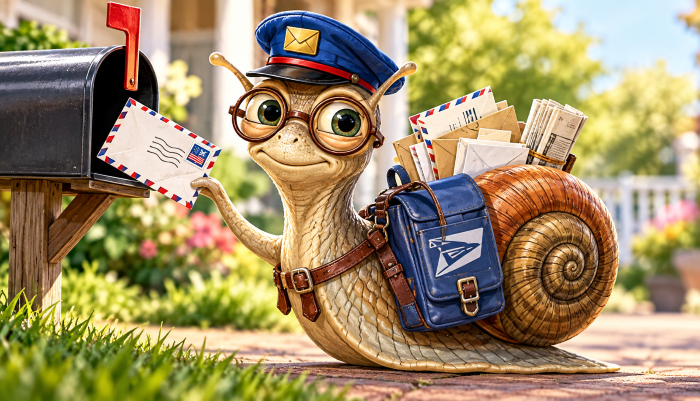
Celebrating World Post Day
This Friday, October 9, is World Post Day, a celebration of the postal system that has connected people across towns, countries, and continents for generations. The date marks the anniversary of the Universal Postal Union, established in 1874 to create an international network for delivering mail worldwide. (United Nations)
The 2026 theme, “One postal network, infinite possibilities,” recognizes that even in a world of texts, social media, and instant messaging, the postal system continues to connect people and communities. (The United Nations in India)
Of course, for those of us old enough to remember life before smartphones, the Post connected us in a much simpler way. It brought letters, birthday cards, postcards, packages – and occasionally something with your name on it that made a trip to the mailbox feel like an event.
Before texting, there was snail mail.
Before texting, we used snail mail: sending someone a message meant putting pen to paper, finding an envelope and stamp, and trusting the Postal Service to do the rest. Today, we can message someone across the country in seconds. We can see when it was delivered, sometimes see when it was read, and then spend the next 17 minutes wondering why they haven’t answered.
It wasn’t always this complicated. There was a time when you wrote your message on paper, folded it, put it in an envelope, addressed it, added a stamp, and dropped it in a mailbox. Then you waited, sometimes for days.
For younger readers, this primitive communication system was known as mail.
Remember When Getting the Mail Was an Event?
Before email inboxes became clogged with advertisements, notifications, and messages marked “URGENT,” there was an actual mailbox outside your house, and checking it could be exciting.
You never knew what might be waiting inside. There could be a birthday card from Grandma, a postcard from a friend on vacation, or a handwritten letter from someone you hadn’t seen in years. Maybe there was even a letter from someone special. Of course, there were also bills. Some things never change.
For children, getting something addressed specifically to them was especially exciting. Seeing your own name on an envelope somehow made you feel important. Someone had taken the time to sit down, write something, put your name on it, and send it specifically to you.
My First Letter: “Master Gerardo Campbell”
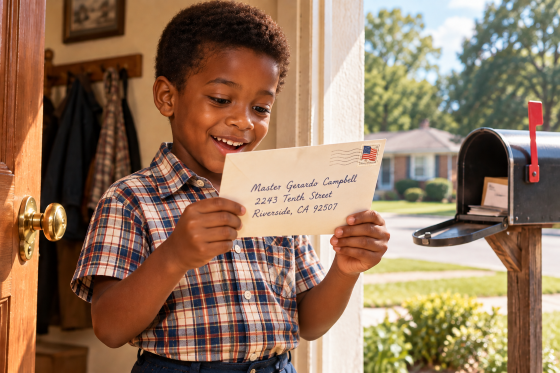
I still remember receiving my first handwritten letter when I was about six years old. What caught my attention before I even opened it was the name on the envelope: “Master Gerardo Campbell.”
Master? At six years old, I don’t recall owning an estate, having servants, or presiding over anything more substantial than my toys. I certainly didn’t know that “Master” was once a traditional form of address for a young boy. As far as I was concerned, someone at the Post Office had apparently promoted me without telling my parents.
What I do remember is how special it felt to receive something addressed specifically to me. It wasn’t my parents’ mail that I happened to pick up. It was my letter. Someone had written my name on an envelope, put a stamp on it, and sent it through the mail just for me.
That little envelope illustrates something we’ve largely lost in the age of instant communication. Receiving a handwritten letter felt like an occasion because someone had invested more than a few seconds in reaching out.
Compare that with today’s family communication:
Parent: “Did you get my text?”
Teen: “Yeah.”
Parent: “Why didn’t you answer?”
Teen: “I didn’t know I had to.”
And thus began another heartwarming chapter in family history.
Fun Fact #1: America’s First Postage Stamps Arrived in 1847
The United States issued its first general postage stamps in 1847. One featured Benjamin Franklin and cost five cents, while the other featured George Washington and cost ten cents.
Before stamps became standard, mailing a letter worked quite differently. Senders could pay postage, recipients could pay it, or they could pay it in part. Rates could also depend on the number of sheets and how far the letter traveled.
Imagine receiving a text message today saying, “Gerardo sent you a message. Please enter your credit card information to read it.“ On second thought, don’t imagine that too hard. Someone will probably turn it into an app.
Fun Fact #2: The World’s First Postage Stamp Was the Penny Black
The world’s first adhesive postage stamp was Britain’s famous Penny Black, issued in 1840. It featured Queen Victoria and allowed a half-ounce letter to travel for one penny.
The idea was revolutionary because the sender could pay the postage in advance. Today, sticking something to an envelope doesn’t seem particularly impressive, but in 1840, this was cutting-edge communication technology.
Think of the postage stamp as the 19th-century version of the “Send” button, except once you licked it, there was definitely no “Undo Send.”
Fun Fact #3: The Original “You’ve Got Mail”
Long before computers announced, “You’ve got mail,” people recognized another familiar sound: the mail carrier approaching the house.
For generations, letters connected families separated by military service, college, work, migration, and marriage. They carried birthday wishes, family news, condolences, congratulations, apologies, and declarations of love.
Because letters took effort, people often thought carefully about what they wanted to say. No autocorrect, backspace key, or delete button. If you made a mistake, you crossed it out, started over, or decided the person you loved could live with the fact you accidentally wrote “Dear Sweatheart.”
Fun Fact #4: The Pony Express Was Surprisingly Short-Lived
The Pony Express has become one of the great symbols of America’s Old West, but it operated for only about 18 months, from April 1860 until October 1861.
Riders carried mail by horseback relay between St. Joseph, Missouri, and Sacramento, California. The approximately 1,800-mile journey could be completed in about 10 days, which was remarkably fast for the time.
Pony Express riders even had rules. Before joining the service, employees were required to take an oath promising not to use profane language, drink intoxicating liquor, or fight with fellow employees. They also pledged to conduct themselves honestly and faithfully. Alexander Majors, one of the company’s owners, even gave employees Bibles.
Imagine applying those rules to modern social media. Half the internet would be unemployed by lunchtime.
Fun Fact #5: ZIP Doesn’t Mean What You May Think
Most of us have written ZIP Codes thousands of times without thinking much about what “ZIP” actually means. It stands for Zoning Improvement Plan.
The five-digit ZIP Code was introduced in 1963 as America’s growing mail volume made faster, more efficient sorting necessary. The first digit identifies a broad geographic region, moving generally from “0” in the East to “9” in the West. ZIP+4 arrived in 1983 to make sorting even more precise.
The Postal Service even had a character named Mr. ZIP to persuade Americans to use the new codes. So, yes, before internet influencers, America had a cartoon postal character encouraging people to write five numbers correctly. Apparently, it worked.
The Lost Art of the Handwritten Letter
Receiving a handwritten letter feels different. You recognize the person’s handwriting before you’ve finished reading the return address. You notice where the writer pressed harder with the pen, squeezed an extra sentence into the margin, or crossed something out. Sometimes there’s even a coffee stain or a smudge.
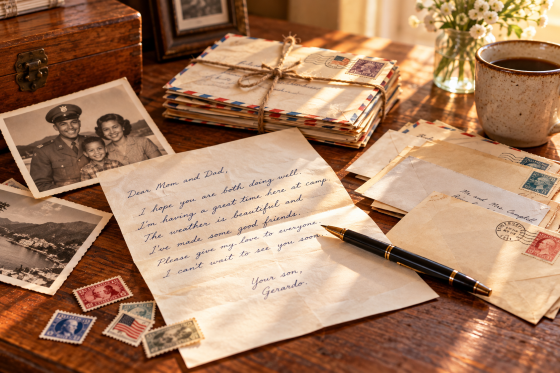
A text message gives you someone’s words, but a handwritten letter gives you a little bit of the person. That’s probably why families often save letters for decades while deleting text messages without a second thought.
Old letters get tied together with ribbon, placed in boxes, tucked into Bibles, saved in scrapbooks, and discovered by children or grandchildren years later. It’s hard to imagine anyone lovingly opening an old cedar chest and exclaiming, “Look! Grandpa’s text thread from 2017!“
Remember Pen Pals?
Before social media allowed us to have hundreds of “friends” we’d never met, children sometimes had pen pals. You wrote to someone in another state or country, told them about your school, family, hobbies, and interests, mailed the letter, and waited for a reply.
You didn’t have profile pictures to examine first, follower counts to compare, or instant replies. It was simply two people learning about each other one letter at a time.
It sounds painfully slow by today’s standards, but perhaps that was part of the charm. Anticipation made each new letter feel special.
Today’s children might find the concept difficult to understand:
Child: “So you sent someone a message?”
Dad: “Yes.”
Child: “When did they get it?”
Dad: “A few days later.”
Child: “DAYS?”
Dad: “Yes.”
Child: “Did you call the police?”
Fun Fact #6: You Can Mail a Brick
Here’s one to share at the dinner table. According to the U.S. Postal Service, you can mail a single brick if it meets postal requirements. Put the destination and return addresses on it, weigh it, pay the proper postage, and off it goes.
Apparently, an envelope isn’t always necessary. This opens possibilities for blended-family communication that probably shouldn’t be explored. If your stepson forgets his lunch, mailing him a sandwich is still not recommended.
Love Letters Required Commitment
Romance also looked different before texting. People wrote handwritten love letters and carefully chose their words, sometimes rewriting entire pages to make everything sound just right.
Today’s romantic message might be, “Thinking about you ❤️.” A letter from an earlier generation might begin, “My dearest Margaret, as I sit beneath the moonlight, my thoughts return once again to you…”
Of course, Margaret then had to wait six days to discover someone was thinking about her. Still, handwritten romance had at least one advantage: you couldn’t accidentally send your love letter to the family group chat.
Families Wrote Because Distance Really Meant Distance
Letters became especially important when family members were separated for long periods. During wartime, military deployments, college, or cross-country moves, letters sometimes became the primary connection between people who loved one another.
During World War II, the United States used V-Mail, short for Victory Mail, to help service members and their families communicate while saving valuable cargo space. Letters were photographed onto microfilm, transported, and reproduced for delivery. According to the Smithsonian National Postal Museum, approximately 1.25 billion V-Mail letters were microfilmed between June 1942 and November 1945.
Those letters carried ordinary family news through extraordinary circumstances: a child’s school accomplishments, news from home, a spouse’s encouragement, or a father’s reassurance. The technology was simple, but the connection wasn’t.
Maybe Snail Mail Knew Something We Forgot
Modern communication is unquestionably faster and easier. A stepdad traveling for work can text his family from an airport. A parent can send a child encouragement before an exam. Grandparents can receive pictures seconds after they’re taken. Those are wonderful benefits that previous generations couldn’t have imagined.
But speed isn’t the same thing as thoughtfulness. A handwritten note requires us to stop what we’re doing, choose our words, and give someone our undivided attention for a few minutes. That can be particularly meaningful in a blended family, where small, consistent expressions of care help build relationships over time.
A stepdad doesn’t need to write a three-page letter beginning, “My Dearest Stepson.” That might raise a few eyebrows. But slipping a short handwritten note into a backpack can communicate something a text sometimes can’t: “I’m proud of the way you handled that situation yesterday. Have a great day.”
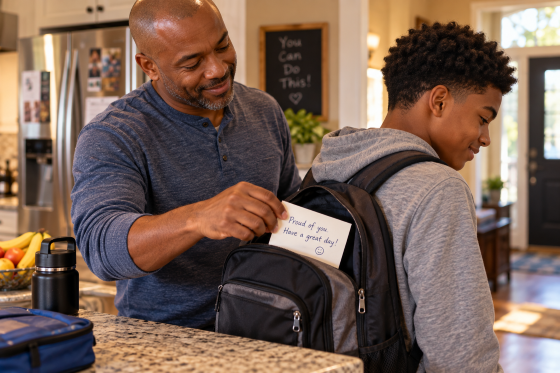
The message may take only 30 seconds to write, but the child may remember it for years.
A Friday Challenge: Go Old School
This weekend, do something delightfully outdated: write someone a note on paper rather than sending an email, text, or direct message.
Write to your spouse. Send your adult child a card. Put a note in your stepchild’s backpack. Mail something to your parents or grandparents. If someone has encouraged you recently, write them a thank-you note.
Your handwriting doesn’t have to be beautiful, and your grammar doesn’t have to be perfect. You certainly don’t need a fountain pen, wax seal, or carrier pigeon. You just need to say something worth keeping.
One hundred years from now, your descendants probably won’t discover your text messages in an old box in the attic. But they just might find your letters.