
When Your Stepchild Is Struggling At School: What A Stepdad Should – And Shouldn’t – Do
How to Support, Encourage, and Guide them without Taking Over


The first sign might be a bad grade. Maybe your stepchild, who normally gets B’s, suddenly brings home a D. Perhaps homework has become a nightly battle, they’re complaining about a teacher, or the child who used to talk about school suddenly doesn’t want to talk about it at all.
Something has changed, and as a stepdad, your first instinct may be, “We need to fix this.” That’s understandable. We care about our stepchildren and want them to succeed. When we see a problem, we naturally start looking for solutions. But before trying to fix anything, start somewhere else. Ask, “What’s going on?” Then listen.
The Report Card May Not Be the Problem
When grades fall, it’s easy to focus on the obvious: “You need to study more,” “You need to stop playing video games,” or “You need to pay attention in class.” Those things may be true, but…
Your stepchild could be struggling because they don’t understand the material, have trouble staying organized, feel overwhelmed by homework, or are dealing with problems involving friends. They may be experiencing bullying, having difficulty connecting with a teacher, staying up too late, participating in too many activities, or becoming distracted by something happening at home. For children in blended families, moving between two households can also create challenges that show up at school.
Or maybe they simply made a bad decision and didn’t study. That happens too. The important thing is not to diagnose the problem before you understand it.
Be Careful With the Word “Lazy”
Few labels shut down a conversation faster than “You’re lazy.” Maybe your stepchild didn’t study. Maybe they procrastinated or spent three hours on their phone and 15 minutes preparing for a test.
There’s an important difference between saying, “You didn’t prepare for this test,” and “You’re lazy.” One identifies something that can change. The other tells a child something about who they are. Instead, try, “You’re capable of better preparation than this. What got in the way?” That doesn’t excuse poor choices. It starts a conversation about them.
Listen Before You Lecture
Stepdads often want to solve problems. It’s one of our strengths, but it can also get us into trouble. Your stepchild says, “I hate math,” and before they’ve finished the sentence, you’re explaining study habits, tutoring, personal responsibility, how important math will be later in life, and possibly telling a story about your own algebra teacher. Meanwhile, your stepchild wonders why they said anything.
Try something different. Listen first, and then ask questions such as, “What don’t you like about it?” “When did it start getting difficult?” or “What’s the hardest part?” One of my favorites is, “Do you want my advice, or do you just need me to listen?” That question can save you both a lot of frustration.

Try the 70/30 Stepdad Challenge. During an important conversation, aim to listen about 70 percent of the time and talk about 30 percent. It’s not a scientific formula; it’s simply a reminder that listening should come before lecturing. James gives us some excellent guidance:
Sometimes the most helpful thing you can say is very little.
Talk With Your Wife Before Taking Over
You’ve identified a problem, and now you’re ready for action: email the teacher, hire a tutor, take away the phone, cancel video games, or create a study schedule. Before taking significant action, however, talk privately with your wife and ask, “Are you seeing what I’m seeing?”
She may know something you don’t. Perhaps the teacher has already contacted her, the problem started at the other household, or your stepchild confided something to her. She may also see the situation differently than you do.
Discuss whether the teacher or biological father needs to be involved and what role you should play.

You and your wife may not agree immediately, and that’s okay. Have that disagreement privately. Your stepchild shouldn’t be sitting at the kitchen table watching Mom and Stepdad debate how to handle them.
Know When to Step Forward
Being a stepdad doesn’t mean standing on the sidelines. Sometimes your involvement can make an enormous difference, especially when your stepchild asks for your help. Maybe you’re good at math, writing is your strength, or you know how to organize a large project. You might quiz them before a test, help create a study schedule, proofread a paper, or simply provide a quiet place to work.
Step forward when your wife asks for your support and when your presence provides encouragement and stability. Sometimes your greatest contribution isn’t academic at all. It might be driving them to school after they missed the bus, bringing them a snack while they’re studying, helping build a science project, or simply saying, “You’ve got this.” Those things matter.
Know When to Step Back
There’s another side to this. Sometimes the best thing a stepdad can do is step back, and that can be harder. Step back when your involvement is making the situation worse, when a matter needs to be handled between the biological parents, when you’re trying to establish authority rather than solve the problem, or when your stepchild clearly needs Mom more than they need you.
Stepping back doesn’t mean you don’t care. It means you’re secure enough in your role to recognize when someone else should take the lead.
Sometimes support looks like standing beside your wife rather than standing in front of her.
Become a Homework Ally, Not the Homework Police
Nobody wants every interaction with a parent or stepparent to sound like, “Did you finish your homework?” “Did you study?” “When is that project due?” “Why are you on your phone?” or “Did you check your grades?” If that’s most of what your stepchild hears from you, don’t be surprised if they start avoiding you.
Help without becoming the Homework Police. Create a quiet place to study, help break large assignments into smaller pieces, quiz them before a test, organize their calendar, explain something when you can, encourage them to ask the teacher for help, and recognize improvement.

Ask about the game. Talk about music. Watch something together, get something to eat, and laugh. Your relationship is bigger than their GPA.
Separate Performance From Worth
Grades matter. Education matters. Effort matters. But a report card doesn’t measure a child’s worth. A child who earns a D isn’t a D, and a child who fails a test isn’t a failure.
There’s an important difference between disappointment in a result and disappointment in a person. You can say, “This grade isn’t what you’re capable of,” without saying, “You disappointed me.” One addresses performance; the other can feel like it addresses their value.
Look for Effort Worth Recognizing
We’re often quick to notice what’s wrong: the missing assignment, bad grade, unfinished homework, or test they didn’t study for. Try looking for what’s improving too. Maybe your stepchild raised a D to a C. That’s progress. Maybe they studied for 30 minutes without being reminded or asked the teacher for help. Those efforts are worth recognizing.
Even if they failed the test but genuinely prepared, acknowledge the effort before discussing what needs to change. Scripture reminds us:
Encouragement isn’t ignoring poor performance. It’s helping someone believe improvement is possible.
Sometimes the Problem Isn’t Academic
Pay attention when school problems come with other changes. Your stepchild may suddenly not want to attend school, frequently complain about headaches or stomachaches before school, withdraw from friends, seem different, become unusually angry when school is mentioned, or experience a dramatic drop in academic performance without an obvious explanation.
Don’t automatically dismiss those changes as “Teenagers.” Ask questions, listen, and talk with your wife. Something may be happening at school that you don’t know about. Bullying, friendship problems, classroom difficulties, or other challenges may require involvement from teachers, counselors, school administrators, or other appropriate professionals.
You don’t need to diagnose everything yourself. Sometimes good parenting means recognizing when you need additional help.
Don’t Rescue Them From Every Failure
This may be one of the hardest lessons for any parent or stepparent.
They forgot the assignment, didn’t study, or waited until 10 p.m. to start a project assigned two weeks ago. Your instinct may be to save them by staying up until midnight to help, email the teacher, or explain why the assignment is late.
Sometimes helping is appropriate, but sometimes it prevents the lesson. Failure isn’t always the enemy. It can teach preparation, responsibility, time management, humility, and resilience.
The goal isn’t to prevent your stepchild from ever falling. It’s helping them learn how to get back up.
Be the Person Who Keeps Believing in Them
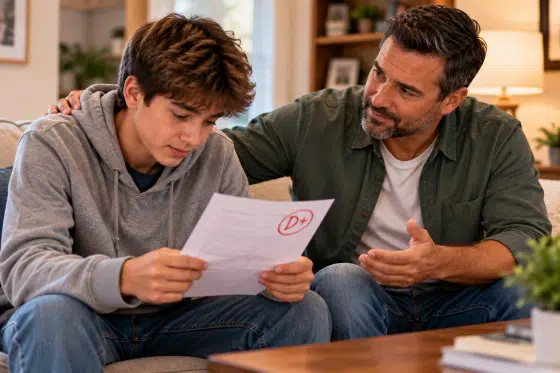
Think back to your own childhood. You probably remember an adult who believed in you. Maybe it was a parent, teacher, coach, or grandparent – someone who saw more in you than you saw in yourself. A stepdad can be that person.
Your stepchild may not remember every piece of advice you gave or every homework assignment you helped with. But they may remember hearing, “I’m proud of how hard you worked,” “One bad grade doesn’t define you,” “What did you learn from it?” “Let’s figure this out,” or simply, “I believe in you.”
Those words are connection deposits. Make enough of them, and over time they build something valuable: trust.
Support Without Taking Over
When your stepchild struggles at school, you don’t have to arrive with all the answers. Start with a question: “What’s going on?” Listen to the answer, talk with your wife, and figure out what your stepchild actually needs from you.
Sometimes you’ll need to step forward, and sometimes you’ll need to step back. You may help with homework one day and help them learn from a mistake the next. At other times, your most important contribution will be sitting beside a discouraged kid and saying, “I know this is hard. We’ll figure it out. I’m here if you need me.”
You can’t take every test for them or solve every problem, and you shouldn’t.
When your stepchild is struggling, what’s your first instinct – to listen or to fix? Share your experience in the Comments below. Your perspective may help another stepdad figure out when to step forward and when to step back.