Helping Your Child Deal With Bullying
How Stepdads Can Help Kids Feel Safe, Speak Up, and Build Confidence

Bullying remains a reality for many children. Sometimes, it’s obvious: a bigger or stronger child physically intimidating another student. Other times, it’s harder to spot.
A child may be mocked because of their appearance, name, interests, clothes, beliefs, family situation, or simply because someone has decided they’re different. There may be no bruises, but repeated teasing, exclusion, humiliation, and rumors can still do real harm.
Federal data show how common the problem is. About 19% of students ages 12-18 reported being bullied during school in 2021-22, according to the National Center for Education Statistics (NCES). That’s roughly one in five students. Among students who were bullied, 22% said it happened online or by text.
The effects don’t necessarily disappear when the bullying stops. Among students who reported being bullied, about 28% said it negatively affected how they felt about themselves, 20% said it affected their schoolwork, and 19% reported an impact on relationships with family and friends. Yet only 44% said an adult at school had been notified.
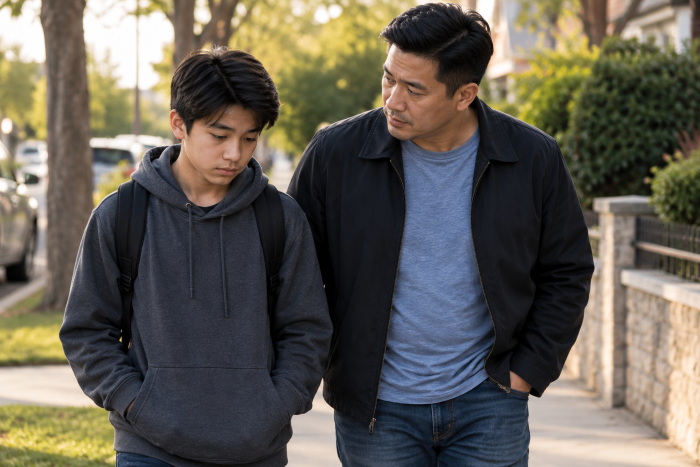
For stepdads, there’s another layer to consider. You may recognize something is wrong but wonder how far you should step in, especially when your stepchild is reluctant to talk.
You don’t have to replace a biological parent to make a difference. Listening, providing reassurance, and working with your spouse can make you another trusted adult your stepchild knows is firmly in their corner.
Know the Warning Signs of Bullying
Children don’t always tell adults they’re being bullied. They may be embarrassed, afraid of retaliation, or worried that getting adults involved will make things worse.
That’s why changes in behavior deserve attention.
Possible warning signs include:
- Suddenly avoiding school, the bus, lunch, or certain activities
- Unexplained injuries or damaged belongings
- Frequent headaches or stomachaches before school
- Changes in sleeping or eating habits
- Losing interest in friends or favorite activities
- Declining grades or difficulty concentrating
- Becoming unusually withdrawn, irritable, anxious, or angry
- Repeatedly losing belongings or asking for extra money
- Suddenly avoiding a phone, computer, or social media
- Becoming visibly upset after receiving texts or notifications
One warning sign doesn’t automatically mean your child is being bullied. A noticeable change, though, gives you a reason to pay closer attention and start a conversation.
For stepdads, learning to look beyond a child’s behavior can help you recognize when silence, anger, or withdrawal may be pointing to something deeper.
Give Your Child Tools to Deal With Bullying
Knowing how to respond can help a child feel less powerless.
Your first instinct might be to tell your child to fight back and “stand up for himself.” Physical retaliation, however, can escalate the situation and create additional problems.
A better approach is to give your child several options and help them choose the response that makes sense for the situation.
Confidence matters, too. Celebrate your child’s strengths, interests, accomplishments, and character. Those everyday words of encouragement help build the sense of self-worth children need when someone else is trying to tear it down.
Simple, everyday ways can also help your child build confidence, from listening and using positive words to encouraging healthy activities and relationships.
Use the Buddy System
If a bully tends to approach your child on the way to the bus, in a hallway, near a bathroom, or elsewhere with little adult supervision, encourage your child to stay near a friend.
There’s often safety in numbers.
A child looking for an isolated target may be less likely to act when friends are nearby.
Walking Away Isn’t Weak
To a child, walking away from a bully can feel cowardly. It isn’t.
Refusing to give someone the reaction they’re looking for takes self-control. Walking away doesn’t mean the bully won. It means your child chose not to let someone else control their behavior.
If your child is being physically attacked or believes they’re in immediate danger, getting away and finding a trusted adult should take priority.
Help Them Control Their Reaction
Getting angry may give a bully exactly the reaction they wanted. Mocking or laughing at the bully can also make things worse.
Help your child practice staying calm, saying as little as necessary, and leaving when it’s safe.
You can role-play situations at home without turning it into a formal exercise. Practice making eye contact, confidently saying “Stop,” and walking toward friends or an adult.
You’re not making your child responsible for stopping the bullying. You’re giving them options so they aren’t trying to figure everything out while frightened or angry.
Teach Your Child to Be an Upstander
What if your child isn’t being bullied but sees it happening to someone else?
They can still make a difference.
A bystander sees bullying. An upstander safely helps.
That doesn’t mean confronting the bully or putting themselves in danger. Your child might invite the targeted student to sit with them at lunch, walk away with them, get an adult, report what happened, or check on the child afterward.
Sometimes, something as simple as sitting beside a child everyone else has decided to avoid sends a powerful message:
You’re not alone.
Don’t Overlook Cyberbullying
Today’s bullying doesn’t necessarily end when the school bell rings.
Harassment can follow children home through texts, social media, group chats, gaming platforms, photos, videos, and other digital spaces.
Talk about cyberbullying before there’s a problem. Children should know they don’t need to retaliate. Depending on the circumstances, they can save screenshots or messages, block or mute the person, report abusive content, and tell an adult they trust.
There’s also a balance between supervision and privacy.
You don’t necessarily need to monitor every conversation your child has online. You do want to create an environment where they can bring you something uncomfortable without thinking, If I tell Dad and Mom, they’re going to take my phone away.
If losing their device feels like the punishment for reporting a problem, some children will simply stop reporting problems.
Keep Communication Open
Asking, “Are you being bullied?” may get you a one-word answer:
“No.”
Try questions that make room for a conversation instead:
- “Who did you hang out with at lunch today?”
- “What’s been the hardest part of school lately?”
- “Is anyone making school uncomfortable for you?”
- “Who do you feel safest around at school?”
- “Have you seen anyone getting picked on?”
- “Is anything happening online that you’d like some help with?”
Don’t feel like every important conversation needs to happen sitting across from each other at the kitchen table.
Some kids talk more easily in the car, while walking the dog, while cooking, while shooting baskets, or while doing something else alongside you. The activity takes some of the pressure off.
Building trust through everyday communication can make those difficult conversations easier when your child really needs you.
Sometimes the best conversations happen when you’re not trying so hard.
What Should a Stepdad Do?
If you discover your stepchild is being bullied, your protective instincts may kick in immediately.
You may want to call the school, confront somebody, fix the problem, or tell your stepchild exactly what they should have done.
Before doing any of that, listen.
Give your stepchild room to tell the story without interruption. Then you might ask:
That’s a simple question, but it gives a child who may be feeling powerless some control back.
Work with your spouse, too. Your stepchild shouldn’t feel caught between adults who have different ideas about what should happen next.
Being a stepdad doesn’t require competing with a child’s biological parents. Your role is much simpler and more important than that: be dependable. Listen. Encourage. Protect when necessary. Follow through when you say you’ll do something.
Those same habits also help you build a stronger bond with your stepchildren, making it easier for them to turn to you when something is wrong.
Your stepchild may not come to you first every time.
Knowing they can still matters.
When It’s Time to Involve the School
Not every disagreement between children is bullying. Kids argue. Friendships change. Feelings get hurt.
Repeated intimidation, threats, harassment, physical aggression, or deliberately targeting another child is different and shouldn’t be brushed aside as “kids being kids.”
If the behavior continues, start documenting it. Write down dates, locations, who was involved, witnesses, and what your child tells you. For online incidents, save screenshots and messages when possible.
Then contact the appropriate teacher, counselor, coach, or administrator. Explain what’s happening, share the information you’ve collected, and ask what the school can do.
Try to approach the conversation as a partnership rather than arriving ready for battle. You and the school have the same basic goal: keeping your child safe. Staying involved with your child’s school can also help you recognize problems earlier and better understand the resources available when concerns arise.
And don’t assume the problem is solved because you reported it.
Check back with your child.
Did it stop?
Do you feel safer?
Has anything changed?
Those answers tell you whether additional action is needed.
The importance of communication is worth emphasizing.
What If Your Child Is the One Doing the Bullying?
This may be the harder conversation.
Good kids can behave badly.
If you learn your child has bullied someone, your instinct may be to defend them: My kid wouldn’t do that.
Maybe they did.
That doesn’t mean you label your child “a bully” and decide that’s who they are. It means you address the behavior honestly.
Ask what happened. Listen to their side without automatically excusing what they did. Establish consequences when appropriate and help them understand how their actions affected someone else.
Then move the conversation toward accountability.
What could you have done differently?
How do you think the other child felt?
Is there something you need to do to make this right?
What will you do if your friends encourage you to do it again?
A poor choice doesn’t have to define a child. Ignoring that choice won’t help them learn from it either.
Model the Respect You Expect
Children pay attention to how adults treat people.
They notice how you talk to your spouse, former partners, relatives, neighbors, teachers, coaches, restaurant employees, and strangers online.
So don’t only tell your children to respect others. Let them watch you do it.
Let them see you disagree without becoming cruel. Apologize when you’re wrong. Establish healthy boundaries. Treat people who are different from you with dignity. Speak up when someone is being mistreated.
Our example will usually teach more than our lectures.
Be Part of Your Child’s Safe Place
You can’t prevent every cruel comment, embarrassing moment, or bullying incident your child may encounter.
You can make sure they don’t face those experiences alone.
Listen before trying to fix everything. Help your child build confidence. Teach them when to walk away and when to get help. Make sure they know which adults they can trust.
For a stepdad, this role can be especially meaningful.
You don’t need all the answers. Sometimes your stepchild simply needs another adult who consistently shows up, listens without judgment, and says:
“We’ll figure this out together.”
Home should be the place where bullying begins to lose some of its power. Not because the outside world suddenly becomes kinder, but because your child knows exactly where they belong and who’s standing beside them.
Originally written by Sandy Mitchell. Updated and expanded for Support for Stepdads.