The Hidden Guide For A Healthy Blended Family
Why Blending Takes Time — And How Secure Attachment Can Strengthen Your Family

You’re not alone. Whenever you need support, resources are available. Studies show
42% of American adults have a stepparent or step-relative. Of all blended families, 40% of
them take about 5-7 years to truly “blend”. This is normal, and not only because it may take
time to go from stranger to trusted family member. Here’s what you should know.
Understanding Attachment Styles in Blended Families
What are Attachment Styles and Why do they Matter?
By the time we reach adulthood, we’ve already developed a certain
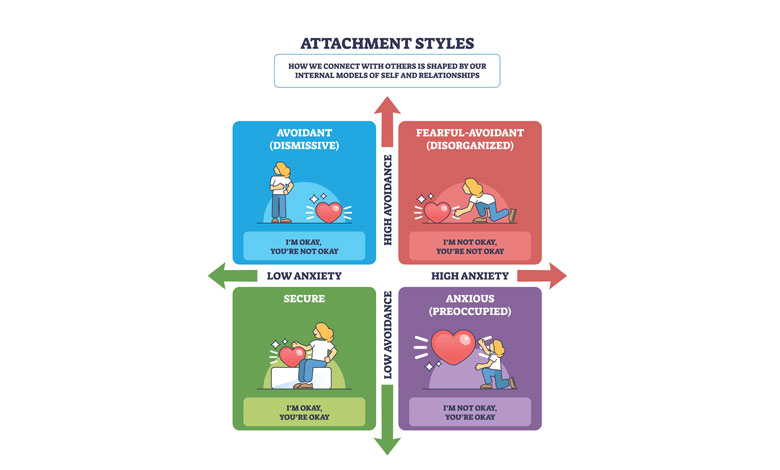
attachment style: secure, anxious, avoidant, disorganized – based on our experiences in
childhood. Attachment styles are a theory created by British psychologist and psychiatrist
John Bowlby and refined by Canadian-American Mary Ainsworth, a developmental
psychologist.
Each attachment style describes four learned behavioral patterns as part of a
psychological safety mechanism that we, as children, created on our own.
- In brief, secure leaning attachments are emotionally secure and feel comfortable with closeness.
- Anxious attachments may want closeness, or even crave it, but fear abandonment.
- Avoidant styles value an independent emotional attachment and may have discomfort with intimacy.
- Lastly, disorganized styles may experience a deep internal conflict of a desire for closeness and intimacy, in combination with a fear of intimacy and abandonment.
How to Identify Your Attachment Style
You can use freely available tools online to assess where you currently are in the
attachment spectrum. One such tool is BondCompass by Attune Labs. A free assessment on
attachment styles that does not collect or share your data without your consent.
The results are meant only for you and will remain private unless you share them with another. There are around 100 comprehensive questions designed to prompt you to pause and reflect before answering.
It can be completed in about 8-10 minutes. Each time you take the assessment, the results will vary because they rely on honest answers. Remember to seek out a trained professional or therapist in this subject to review your results with you.
Attachment Styles are Patterns – Not Permanent Labels
I must note at this point that attachment styles are not fixed at a point in time in your
life and are not meant to be used as a diagnosis or personality type. It may and likely will
change with time and depend on who you are currently talking to, ranging from strangers to
your closest friends and family.
Attachment styles are changeable patterns of psychological behavior and should not
be used as weaponizing labels (“my stepparent is avoidant, this is the source of problems”).
This same tool can be used to help each other reach more secure leaning attachments. Here is how that impacts the blended family members.
How Attachment Styles affect each Member of a Blended Family
Attachment Styles and Children in Stepfamilies
For the children: realistic expectations are set with an understanding that fully adjusting
to the blended family may take 5-7 years. When they have feelings of split affections or loyalty,
that is completely normal to feel.
Attachment Styles and Stepparents
For the stepparent: by understanding your attachment style, you can help yourself better
respond to rejection from your children in your blended household. Secure-leaning stepparents will be able to handle rejection better and maintain their efforts in building healthy
relationships.
Attachment Patterns in Biological Parent
For the biological parent, understanding any avoidant tendencies can better explain
desires to escape from a conflict rather than seeking a healthy resolution. Being equipped
with that understanding can lead to a stronger relationship with your spouse and children after
a conflict rather than weaken it.
How Attachment Styles Influence Marriage in Blended Families
For the couple: When you understand your partner’s attachment styles, you can grasp
the “dance” in a conflict and more easily avoid the “mind” games. When practiced, a couple
can break their negative cycles by recognizing attachment style actions and reactions.
When it comes to applying an understanding of attachment styles to stepdads and
stepmoms, there are a few tips and suggestions that respected organizations and professionals in this field in this area provide:

What Experts Say About Healthy Stepfamily Bonding
According to the American Psychological Association (APA):
- Couples can build a relationship that resembles a trusted counselor in partnership, rather than
a rebuke and set consequences style initially. - Biological or custodial parents should be the primary parental figure who is responsible for
management and discipline until the stepparent’s bond is solidified. - It should be noted the children of both genders prefer verbal affection, such as
compliments and praise over physical affection, such as embracing and kissing.
Dr. Patricia Papernow: Connection Before Correction
From the research of Dr. Patricia Papernow in “Connection Before Correction.”
- It is important to establish a relationship before taking on a disciplinary role.
- Having the understanding that becoming a truly healthy blended family will be a gradual
process. It is “not like blending a smoothie”. - Having the grace to let the parent-child relationships grow naturally is essential.
Five Research-Based Domains of Effective Stepfamily Parenting
Research published in the Journal of Family Relations: Interdisciplinary Journal of Applied
Family Science indicates there are five domains of effective parenting in stepfamilies:
1. “Maintaining close parent-child bonds.”
2. “Establishing appropriate parent-child communication boundaries.”
3. “Exercising parental control.”
4. “Supporting stepparent to stepchild relationship development, and
5. “Facilitating stepfamily cohesion.”
The Emotional Challenges of Modern Blended Families
Let’s take a brief moment to take a step back. Stepfamilies are a growing category of
family structure in today’s world. According to scientific studies published within the National
Library of Medicine, the implications this has for the children are how they internalize and
externalize their problems when they need to for family members, and to others.
This has an elevated risk of maladjustment in terms of their school, mental health,
and behavioral patterns if not accounted for with time. In combination with the lack of social
and culturally recognized norms, laws, and institutional support, providing language to support the dialogue needed for healthy relationships presents a challenge more and more
families face. You are not alone. There is support and resources that can aid you.
Practical Steps to Build Secure Attachment in your Stepfamily
Here’s where you’re provided with practical steps to promote an idea of earned secure
attachment. A term coined by Jane L. Pearson, a researcher who performed a study on the
subject in 1994.
In general, for all attachment styles, use your years of maturity and wisdom to heal your
inner child and foster inner and outer grace and empathy for yourself and others. Allow
yourself the bandwidth to know your core needs and wounds matter. This area of personal
growth is something you can work on yourself without your original caregiver.
The 80/20 Rule for Emotional Presence
Try to adhere to the 80/20 rule: 80% of the time, stay within reason. Allow yourself 20% imperfection; it’s okay. Younger family members can still develop their secure attachments.
Repairing Conflict to Strengthen Bonds
Make a conscious effort to communicate to repair concerns when a misalignment happens. If you can’t repair it, it’s not your fault, but try to repair it. The result strengthens rather than weakens relationships.
Progress Over Perfection in Blended Families
Remember that blending takes time, perhaps 5-7 years. Blending is far removed from
blending a smoothie. Like blending a family that likes to eat pasta with a family that likes to
eat with chopsticks and insisting everyone eat with it will only cause discord instead of
unity. You’re looking for progress, not perfection. Change occurs with small and consistent
efforts instead of dramatic transformations.

Strengthening the Couple Relationship First
The way couples can grow and maintain a healthy family relationship is to find time for
regular dates, trips without the children, and working as a team on parental approaches. With a
strong foundation, the whole family can be supported.
It also helps to understand that every family member has their own journey. Not better,
not worse, not faster or slower, just uniquely theirs. Children may grieve the loss of the
original family. Stepparents will suddenly find themselves in a uniquely different role. Finally,
biological parents may feel torn between loyalties in the family dynamics. Just know that resources are available.
Therapists and counselors who specialize in family behavioral science, in addition to
attachment styles, are an excellent type of professional to seek out. When further educating
yourself through reading, podcasts, and relevant courses, they can provide guidance, especially if it is a family effort.
Lastly, there’s the famous saying, “It takes a village to raise a child.” Find your community among friends, family, and neighbors. School teachers and other parents at a parent-teacher conference may also be a source of support when your ideals are aligned.
Role-Specific Advice for Stepmoms, Stepdads, and Parents
Advice for Stepmoms
For stepmoms: resist the temptation to immediately assume the “caretaker” role.
Take everything slowly at first and follow the children’s pace. Consider yourself more of an
aunt figure initially. Try also to avoid comparing yourself to the biological mother. When time
allows during the day or week, take the time out for self-care, which prevents burnout from
overworking.
Advice for Stepdads
For the step-dads: Stay actively engaged and resist the urge to fall back to the
“breadwinner” role. Maintain your interests and hobbies, and let the biological parent handle
order and structure for the children, including disciplinary actions initially. The boys may adapt
to your presence faster, but the girls will see you as a reliable, consistent father figure with
time and patience. Grand gestures will matter less than your presence and consistency.
Advice for Biological Parents
For the biological parents: continue spending 1:1 time with your children while
supporting your partner’s bonding efforts without forcing it. Resist temptations to speak ill of
your ex-spouse in front of the children and act more as a “gatekeeper” who facilitates step-
parent to child relationship. Always remember to take time to heal your own attachment
wounds; they impact your parenting.
Creating Unity as a Family
Family: Create new traditions as one. How regular family meetings and having clear
household rules everyone agrees on, rather than being forced to comply. Praise the wins and
positive growth for all. Sometimes it’s the unexpected kindness that can create breakthrough
moments.
You are not Alone: Support for your Stepfamily Journey
In closing, I will end with a quote:
Not sure of your attachment style? Take the free assessment and talk with a family therapist about what it means for your stepfamily.