
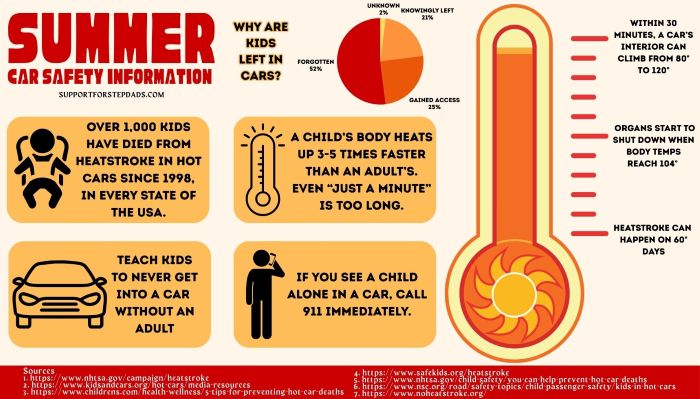
Since 1998, over 1,000 children have died in hot cars, each one a heartbreaking loss that was entirely preventable. On average, 37 young lives are lost each year to vehicular heatstroke, and as our summers are getting hotter, these numbers are going up. In 2024, 41 children perished in hot cars; in 2025, not even halfway through summer, the number is 16.
These statistics are not mere numbers; each one represents a family shattered by unimaginable grief. It’s every parent’s worst nightmare: the gut-wrenching realization that a momentary lapse has resulted in irreversible tragedy.
But with your attention, we can prevent these tragedies. Here’s what you need to know to make sure this never happens to you and your loved ones.
How and Why These Tragedies Happen
To combat these preventable tragedies, it’s essential to understand the factors that contribute to this unfortunate situation. There are four sets of circumstances that lead to a child dying of heatstroke in a hot car:
- Unknowingly left: 52% of deaths occur when a caregiver forgets a child in the car.
- Children gaining access: 25% of deaths happen when children get into unattended vehicles.
- Knowingly left: 21% of deaths occur when children are intentionally left in the vehicle, for example, like when the driver runs into a store for “just a minute” and leaves the child in the car.
- Unknown: About 2% of all child heatstroke deaths have an unknown cause.
To understand how you can forget a child in the car, you need to know how your memory works. The human brain has two types of memory systems: habit memory, which enables automatic actions, and prospective memory, which allows you to remember to do something in the future. Both of these can contribute to the risk of forgetting a child in the car.
When a parent is under stress, sleep-deprived, or experiencing a change in routine, the prospective memory system can fail, allowing the habit memory system to take over. Research shows that distractions or external factors, such as exhaustion, can cause your action plan to fail rapidly, even in a matter of seconds.
Driving to work, school, or daycare is often part of a routine, and it can lead a parent to take the usual route without consciously remembering that the child is in the car. And if the child is quiet or out of sight, such as in a rear-facing car seat, there may not be cues to remind the parent of their presence. It only takes one lapse in memory for tragedy to strike. This is why many newer cars have automatic rear-seat alarms; if your car does not, aftermarket solutions are available.
Some tragedies occur due to miscommunication among caregivers or because a child gains access to a vehicle unnoticed. About 25% of all hot car deaths come from a child getting into a hot car on their own. You can prevent this by always locking your car and teaching your child not to get into a car without your permission.
The Science of Hot Vehicles & Child Physiology
It’s also important to understand why parked cars pose a significant danger to children.
As we are reminded in Proverbs 27:12, “the prudent see danger and take refuge, but the simple keep going and pay the penalty.”
It’s not just that it’s hot out; it’s that cars create the perfect conditions for these tragedies to arise. As spaces enclosed by metal, temperatures inside a vehicle can rise quickly, increasing by 20°F or more in just 10 minutes. On an 80-degree day, the CDC notes the inside of a car can hit 109°F in 20 minutes.
And once your core temperature reaches 104°F, major organs begin to shut down. With their smaller bodies, children overheat three to five times faster than adults, making these temperature spikes particularly deadly.
Heatstroke Death: The Numbers that Tell Stories
Tragic stories across the U.S. and around the world highlight that hot car deaths happen to families of all backgrounds. They have occurred in every US state and around the world, and babies and toddlers are at the highest risk. Texas and Florida have the highest number of hot car deaths,
It is important to remember that this can happen to anybody. Not just negligent or “bad” parents experience this.
Instead of shaming people, it’s more important to spread safety information and ensure that everyone is aware of these potential dangers. It can happen to anyone, and the best defense is awareness.
Prevention Tips and Tools
Keep these safety tips in mind for a great summertime experience!
- Never leave a child in a car, even for a minute.
- Remember that cracking windows or parking in the shade does little to prevent interior heat buildup.
- Always check the back seat before locking your vehicle.
- Use memory triggers, like placing a needed item, like your purse, phone, or work badge, in the back seat so that you have to check the back before you get out of the car.
- Lock cars when not in use.
- Make drop-off check-ins part of your routine; call or text your partner after you drop off your child, and follow up if the check-in didn’t happen when you were supposed to receive it.
- Install reminder apps or aftermarket car seat alarms if your car doesn’t have a rear seat reminder.
- Teach kids that cars are not play spaces and make sure they understand never to climb into a car without an adult.
For additional information, statistics, and resources, consult the following links:
- Child Heatstroke Prevention: Prevent Hot Car Deaths | NHTSA
- Kids and Cars
- 5 tips for preventing hot car deaths – Children’s Health
- Hot Cars | Safe Kids Worldwide
- You Can Help Prevent Hot Car Deaths | NHTSA
- Kids in Hot Cars – National Safety Council
- No Heat Stroke
Call 911 immediately.
If you see a child alone in a car, call 911. Don’t wait. It doesn’t matter if the window is cracked, or if the car is in the shade, or if the child looks fine. If you can, try to remove the child from the car, even if you have to break a window. Good Samaritan laws protect those who act to save a life, and no property is more important than the life of a child.
Many states and countries criminalize leaving a child unattended in a vehicle, even if the act is unintentional. In the US, 20 states have laws against leaving a child in a car, and other states are pushing for similar legislation. Sharing info about campaigns like the NHTSA’s “Stop. Look. Lock.” helps to raise awareness. The best defense is education.
One More Check Can Save a Life
Every parent must build the habit of checking the back seat and spreading awareness. One more check can save a life. Together, we can prevent these tragedies from happening again.
While you might think that you’ll never forget your child in the car,
In every aspect of life and parenting, nothing is more important than keeping our kids safe. For more advice and information about keeping your family healthy and protected, Support for Stepdads’ health articles have the information you need.